Category Archives: News

After The 600

Any day you get to train in the Art of the medieval Italian sword master, Fiore dei Liberi, is a good day. When you find yourself at The 600 – a 3-day,  “All Fiore, All the Time” workshop hosted by the Chicago Swordplay Guild, you’ve pretty much died and gone to heaven.

At least, that’s the opinion shared by the close to 50 western martial artists from the US, Canada and Europe who converged on the DeKoven Center in Wisconsin last month to honor Fiore, his Art and the 600th anniversary of the presentation of his Il Fior di Battaglia (the Flower of Battle) to his patron, Niccolò III d’Este, Marchese of Ferrara (1383-1441).

Held from Friday, September 10th through Sunday, September 12th on the beautiful, picturesque grounds that are also home to the biannual Western Martial Arts Workshop (WMAW), The 600 gave students of Fiore’s Art a deep, personal immersion experience, with intensive training offered by well-respected instructors from the Historical European Swordplay community: our own Gregory Mele, Chicago Swordplay Guild (USA); Sean Hayes, Northwest Fencing Academy (USA); Guy Windsor, School of European Swordsmanship (Finland); Mark Lancaster, The Exiles, Company of Medieval Martial Artists (UK); Scott Wilson, Darkwood Armory (USA); and Bob Charrette, Forteza Historical Swordwork Guild (USA).

In addition to the formal classes offered, The 600 also included a fascinating panel discussion and Q&A on Fiore and his work, taking full advantage of the amazing brain trust of instructors we had on hand. It was the first time the CSG has included this kind of activity, and it was a big hit with the participants. The weekend also included two feats of arms – an unarmoured tournament of sword, dagger and lance open to everyone; and an Armoured Pas d’Armes, an invitational tournament that celebrated the knightly art with sword, lance, and axe.

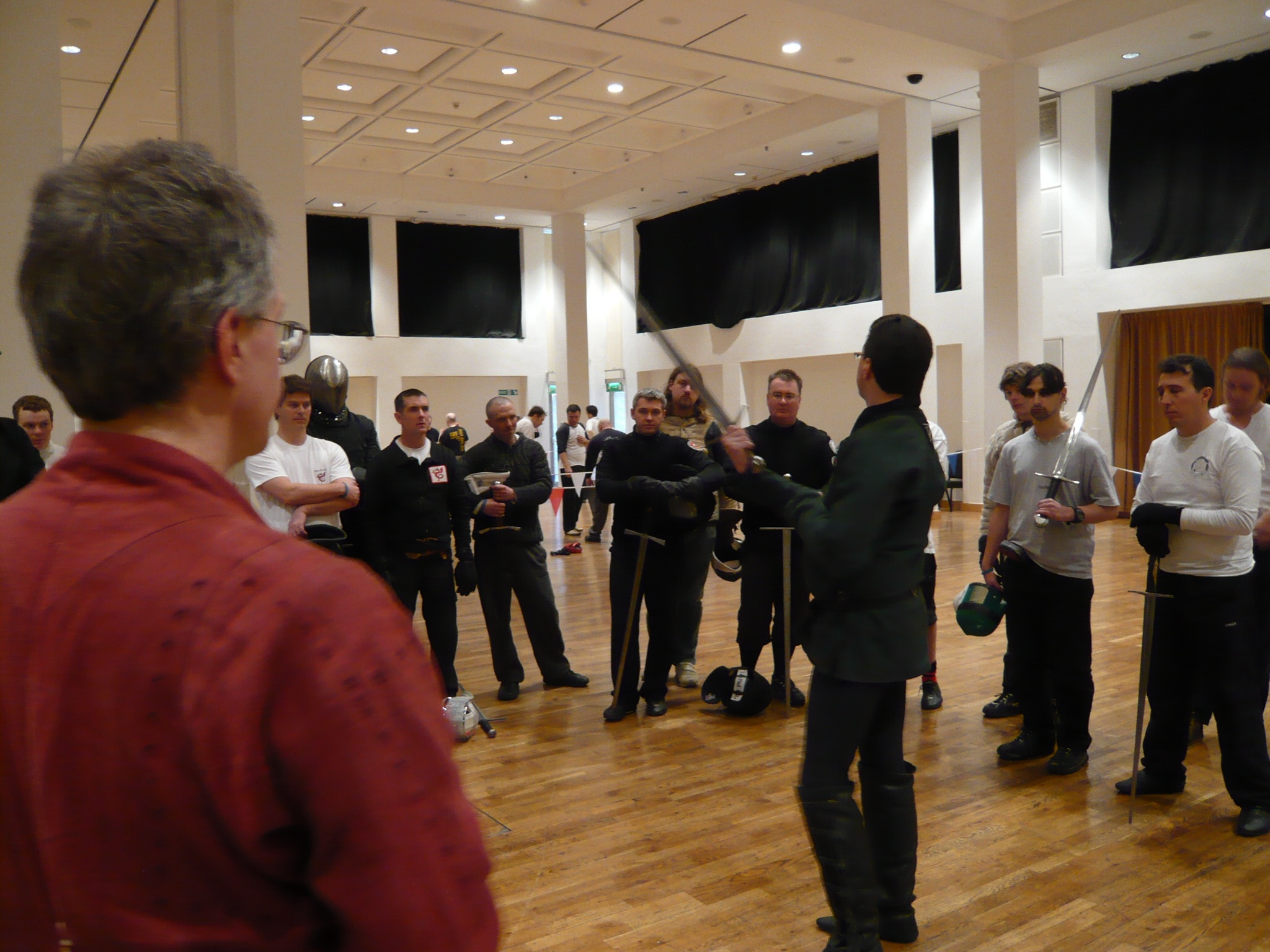
Several of the instructors remarked that the participants’ skill level and familiarity with armizare enhanced the teacher’s ability to challenge us more, mentally and physically than was typical in more “generalist” events. This made the learning experience all the more valuable to us. It also contributed to the glazed look of happy exhaustion shared by every student! Here are some of the class highlights:

Application of Fiore’s Art to Positions of Disadvantage (Scott Wilson) – We all love Scott Wilson for his incredibly beautiful swords (Darkwood Armory), and many of us enjoyed shopping from the back of his truck in between classes on Saturday. But, Scott is also a longtime martial artist and an excellent instructor. In this class, Scott gave us some very interesting ideas about using Boar’s Tooth as elbow shields against strikes and as offensive tools for CQC.  Perhaps the most interesting lesson that Scott shared was his interpretation of Fiore’s daga vs. spada.  Against a mandritto, Scott had us move directly into the strike, using the dagger to block the blow with as close to zero pressure as possible.  After the block, Scott redirected the sword down and to his right, and from there used his dagger for a counter attack.

Improve Your Survival Odds with Proper Cutting Mechanics (Sean Hayes & Gregory Mele) – Sean is always one of our favorite guest instructors, bringing a depth of knowledge and contagious enthusiasm to all of his classes. While this was not a class on cutting basics, he worked us on the basics with gusto, helping us to hone our cutting skills using a coiled back-weighted stance for power and “hand protection”; correct hand-foot timing; how to cut fendente by pushing with the top hand and pulling with the bottom hand; targeting our cuts to strike “below the beard” (using our own Jacques and his beard “Francois” as a visual aid); and projecting power with more effectiveness. We also learned from Greg how good solo drills are not just about moving from one guard to another – they are dynamic tools for examining how to attack and defend as if you are facing an opponent. After practicing a few sequences where we learned both agent’s and patient’s actions, we partnered up to train and examine why the patterns of attack/defend work as they do in a montante sequence called “Driving the Foe Before You”.

Down You Go: Two Ubiquitous Throws of Armizare (Greg Mele, assisted by Jesse Kulla CSG) – In this class, about a dozen students threw themselves into two of the most basic throws in the system – the “rear leg takedown” (hip throw) and the “collar throw” (diving throw) – learning important applications when unarmed and when using various weapons. When dealing with daggers, for example, Greg told us not to do just block with our hands, but to “swat his hand away like a bear.” Think of your defensive action as a powerful attack of its own. With swords, a pommel strike should be thought of as an “upper cut”.  Instead of just striking your opponent, really knock his head back and up and follow through with a “diving throw”.

Playing with the Plays: Making Techniques Adaptable, Applicable and Fun (Guy Windsor) – Incorporating his concept that what we need to know tactically is always shown somewhere in the Maestro’s manuscripts (largely the Getty), Guy gave us some great training tools that center on linking Fiore’s plays.  By examining the circumstances you are in, you can know what to do next (his “Decision Tree”). Guy also loves to draw on plays from all over the Getty, demonstrating how he sees the book as always interrelating, no matter what section you are reading.  One of his favorite plays, for example, is the 8th Play of the Master of Coda Lunga on Horseback- the hand grab and pommel strike – found on the 6th to the last page of the manuscript and which Fiore says “counters all the plays that come before this” (Tom Leoni translation).

KISS – Keep it Simple Student (Mark Lancaster) – Our good friend from across the Pond taught his heart out and kept the laughter flowing, in spite of the fact he was still recovering from a slipped disk. In this class, Mark showed us how the four unarmed poste follow through into Fiore’s daga section and then into plays of the longsword as just a variation on a basic theme. One key lesson: students of armizare need to have the core of Fiore’s art internalized so that we don’t have to think about how to frame the poste and which guards have what characteristics.  Mark also shared his insights on the position of the first Master of the Dagger.  As Greg has pointed out to us numerous times, this position is seen several times throughout Il Fior di Battaglia, especially in the sword in one hand section.

Zogho Stretto – Breaking the Distance (Mark Lancaster) – Mark, also lovingly referred to “Puss in Boots”, took us into tactical options we have with the incrossada.  When both players pass and cut fendente, binding on the forte of the blade and getting all sloppy in the Zogho Stretto, we have what he calls a “Train Wreck”.  (Not a Fiore term, but the Maestro would have agreed had medieval Italy had a Metro system.) Avoiding this situation was the crux of his class, and Mark threw a lot of tactical options at us that we could employ.  A couple key points: The attacker is always closing to Zogho Stretto if he is using single-tempo action.  The defender can choose to engage at Stretto, or he can step out of range, moving offline or even taking a small step back to engage at Largo. The first decision lies with the defender.  Mark also talked about the option of stepping without really going anywhere.  Here you step forward and then back into place to change your lead foot, but distance stays the same.  This was a challenging class for a lot of us, but we walked away with plenty of food for thought and fuel for future training.

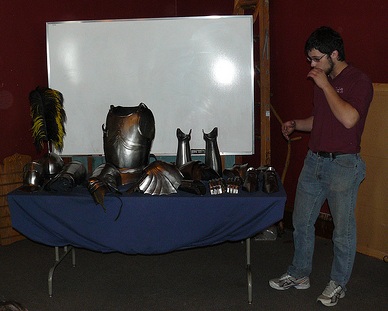
How to Open a Can Without Cutting Yourself: Techniques for Fighting in Harness (Sean Hayes, assisted by Gregory Mele and Alex Spreier (Northwest Fencing Academy) –  About 10 hearty students put on their kits – from full harness to virtually no harness – and joined Sean as he taught us how instructions for  armoured fighting techniques are not only covered in Fiore’s spada en arme (sword used while in harness) sections of his manuscripts, but also in the abrazare, dagger, single-sword and two-handed sword sections.

Ponderous, Cruel and Mortal: Dei Liberi’s System of Axe Play (Greg Mele) – This introductory class to Dei Liberi’s instructions on the poleaxe drew many new students of this weapon, including CSG’s very own master of the rapier, John O’Meara. Greg began with the poleaxe poste and then took us through set plays that drew on core actions of sword and spear play. As one energetic CSG novice noted, the poleaxe as a weapon is dramatic and well balanced, and its movement, “equal parts graceful and threatening”. No wonder it’s a favorite among so many of us.

Attacker’s Choice: Responding to the Bind and Connecting Largo to Stretto (Guy Windsor) – For many of us, the most influential classes of the weekend were those taught by Guy.  As one CSG free scholar noted: Guy’s interpretation of stretto and largo while crossed at the half-sword is a game-changer.  His key point is that Zogho Largo and Zogho Stretto are more than a statement of measure. Zogho Largo is defined as a crossing of the swords during which your opponent’s point is not threatening you, and the bind is soft enough that you can leave it without immediate fear of being struck. Zogho Stretto he describes as a crossing of the swords in which the opponent’s point threatens you, and he is bound hard enough that to remove pressure from the bind would lead to your immediate and painful death.  Guy took us deeper into the plates and writings found in Fiore’s Flower of Battle, giving us a brilliant method for visualizing and teaching the concepts of range as it pertains to Fiore’s system.

Patterns of Remedy: Treatise Organization and Internal Connections in Fior di Battaglia (Bob Charrette) – Hat’s off to Bob, because his fascinating presentation really fed the minds of the armizare scholars at The 600! Bob has reexamined Fiore’s system of Remedies, Scholars, Counters and Counter-Counters, setting it into visual synoptic tables that reveal an even higher level of internal organization and forethought than is generally recognized.

Spontaneous Tactical Response Skills for Freeplay (Sean Hayes) – Sean is a master at developing live drills that directly lead a student into free play.  His class systematically developed each drill, first keeping things simple and even “choreographed”, and eventually added more and more variables until we were pretty much doing focused sparring.  We also learned some great drills for training with odd numbers. The 3-person drill we did, where as soon as you defend, you turn and attack the third training partner, really turned up the intensity while allowing us to keeping training safely. At the end of the class, we were thoroughly warmed up enough for a few rounds of focused and spirited freeplay.  Sean had us do two-minute rounds, with one person from each training trio marshaling and giving advice.

Round Table Discussion – All Instructors

Rainy skies on Friday had us quickly change the afternoon schedule from medieval mud wrestling (so to speak) to a panel discussion that we students found both invaluable and amusing – thanks to the verbal cutting and cross-sniping between the instructors.  The discussion kicked off with Mark’s question as to whether Fiore’s teachings were meant for battlefield combat or judicial tournaments. The consensus was “both”. As Greg put it, the “Art of Arms” is designed to teach you how to fight, with the question of what circumstances coming later.  If you train for battlefield combat, you can apply those lessons to one-on-one circumstances and tournaments.  However, if you just train for tournaments, it is difficult and perhaps deadly to apply those lessons on the battlefield. Other topics discussed involved what Fiore meant by a “zuparello” (a cloth “armor” jacket for fighting vs. a doublet); the importance of studying all of the Fiore manuscripts, not just one, and in turn studying all sections of the manuscripts; what is canonical in the manuscripts and what is not (if Fiore shows it or describes it, it is canonical); and how we need to expand our study beyond weapons and combat methods to the culture and physical artifacts of the time.

Of course, most of us came to test out our fencing skills, and we had plenty of opportunity!

Unarmoured Tournament. The first fencing forum was an unarmoured tournament using the sword in two hands, sword in one hand, and spear. And was this FUN! The format was a variation on the Belgium rules, where each bout was fought till one player had accumulated three points.  And the rules are tough – a strike to the head or the sword arm counted for three points.   The winner of each bout remained “king of the ring”, and was allowed a king’s strike after being hit.  It paid to be king: double-kills went to the higher strike on the body, with the king taking any ties.  With the exception of the arming sword portion of the tournament, fencing was clean and crisp. Unfortunately, a lot of us started to default to our various Bolognese, backsword, SCA, and FMA experience – which we vow to you, Greg, will not happen at the next Fiore Con! Of course, following the tournament came the beer, scotch, cigars and hilarious storytelling.

This year’s victors were Keith Jennings, CSG (Longsword), Scott Wilson, SAS (Arming sword – he edged Keith out by one fight), and Dave “Sparky” Farrell, CSG (spear). Had all bouts been combined, Keith would have been the victor. We are proud of you guys! And an extra salute goes to Mark Lancaster for his Fiore-inspired sword throw at Jesse during the martial challenge. Awesome, scary, and really cool!

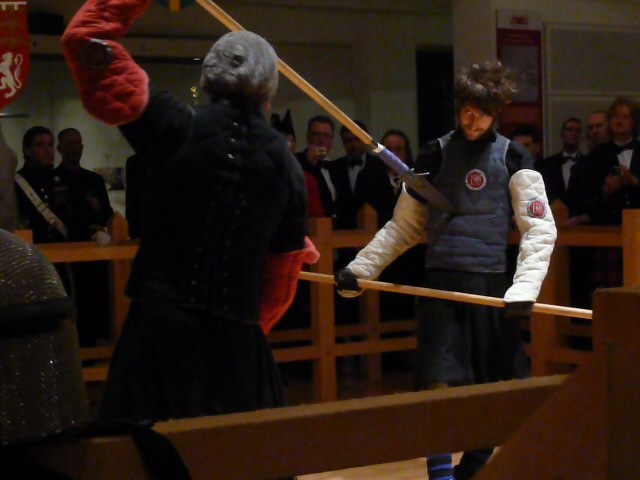
Armoured Tournament. The armoured deed of arms was an expansion of last year’s event at WMAW 2009. With the sun shining and crowds cheering from the sidelines, CSG’s Jesse Kulla, Dave “Sparky” Farrell and Leo Lastre stood as defenders and took challenges with sword, dagger, spear and axe from Bob Charrette, Sean Hayes, Alex Spreier and Scott Wilson. Scott’s spear bout with Leo is regarded by many as the highlight of the feat of arms. A “huzzah” with a wink must also be given to Bob Charrette for his cunning use of the powder-filled hollow poleaxe on Jesse.  All in all, this whole event was just absolutely great to watch! See videos of the tournament on YouTube!

Our gratitude goes out to everyone who made The 600 possible! More images of the event are available for viewing.

WMAW 2011. CSG’s next major workshop is WMAW 2011, which will take place at the DeKoven Center in WI sometime in early Fall. Check WMAW.us for regular updates!

The 601? Will there be anything like The 600 Revisited? Stay tuned. The rave reviews we’ve received on The 600 have us thinking about another all-Fiore workshop in 2012…

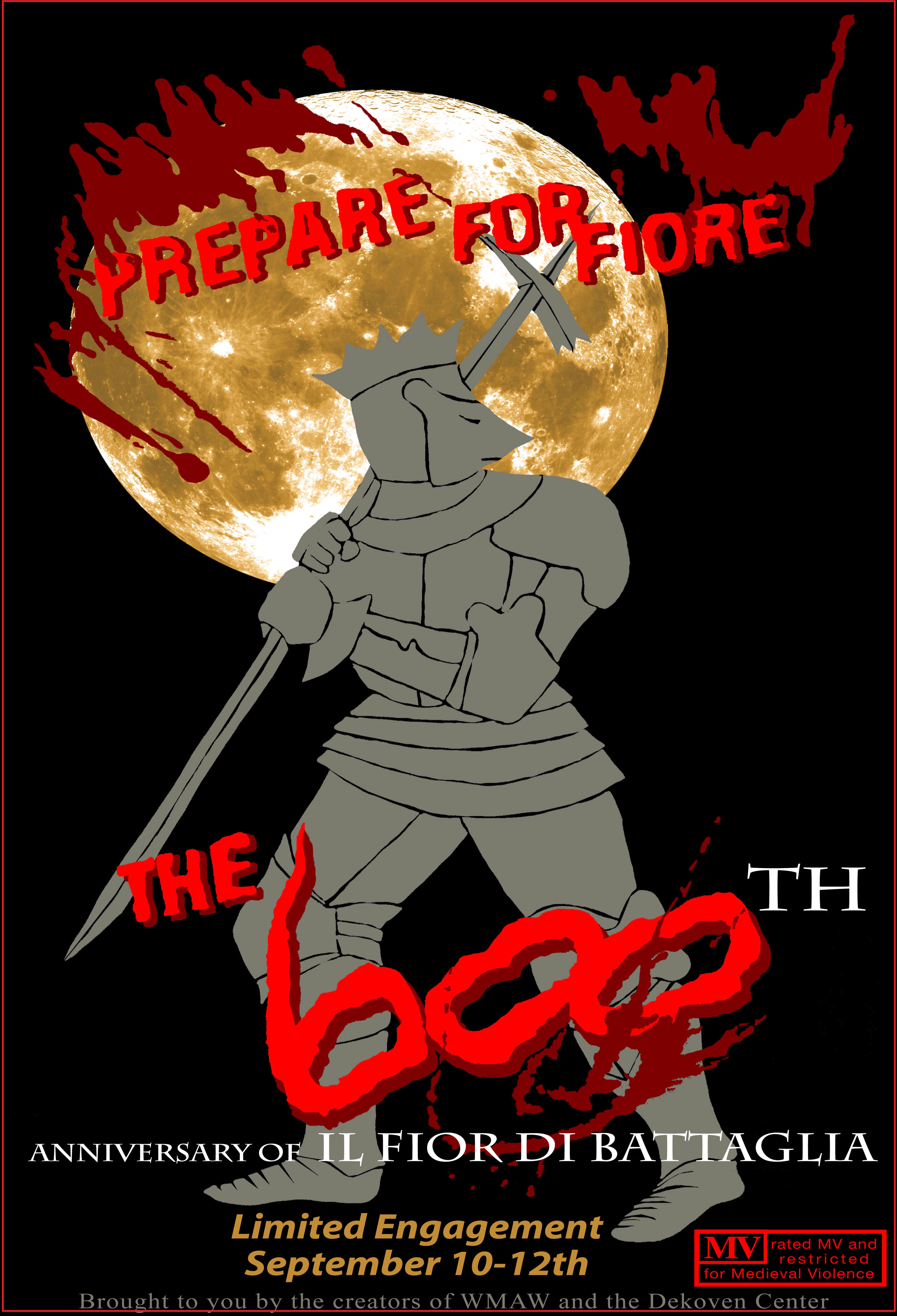
The 600 – Prepare for Fiore!

In 1410, Fiore dei Liberi, an aging condottiero and master-at-arms to some of Italy’s most renowned warriors, presented a book to the bellicose Niccolò III d’Este, Marchese of Ferrara (1383-1441) containing the sum of four decades of knowledge won in the training hall, siege, battle and  five duels with rival masters. He named this work Il Fior di Battaglia, the Flower of Battle, composed so that the “art might not be forgotten”.

Six hundred years later, a small gathering of martial artists from around the world will prove him right!

The Chicago Swordplay Guild is pleased to host this invitational, three day event in honor of Maestro Fiore and his Art. The schedule of events includes:

Classes taught by an international slate of instructors:

  • Bob Charrette, LaBelle Compagnie (USA)
  • Sean Hayes, Northwest Academy of Arms (USA)
  • Mark Lancaster, The Exiles – Company of Medieval Martial Artists (UK)
  • Rob Lovett, The Exiles – Company of Medieval Martial Artists (UK)
  • Gregory Mele, Chicago Swordplay Guild (USA)
  • Roger Siggs, Rocky Mountain Swordplay Guild (USA)
  • Guy Windsor, School of European Swordsmanship (Finland)

The schedule and class descriptions are included in this PDF:

Fiore 600 Schedule

The 600 Class Descriptions

In addition to formal classes there will be a round table discussion and Q&A on Fiore and his work, and two feats of arms:

  • A Friday “Vespers Tournament” – an unarmoured tournament of sword, dagger and lance, open to all attendees.
  • A Saturday, Armoured Pas d’Armes – an invitational tournament, celebrating the knightly art, to be fought with sword, lance, and axe.

(Full details of the tournaments will be forwarded to attendees.)

Located at the picturesque DeKoven Center, home to the Western Martial Arts Workshop, the conference is a retreat with attendance limited to the 60 students that DeKoven can host. Your registration fee  includes entry, lodging and all nine, hot meals.

This is a unique event and a unique opportunity to train in a private environment with some of the most renowned, modern teachers of the art of Armizare. Act now, because spaces will go fast. We look forward to crossing swords with you!

Details:

Dates:

September 10 – 12, 2010

Location:

The DeKoven Center
600 21st Street
Racine, WI 53403

(Details for getting to Racine can be found on the WMAW website)

Accommodations:

On campus; all rooms have two single beds. You will be able to request the roommate of your choice when you register, and we will make every effort to accommodate you.

Nine hot meals.

Costs:

$325.00 inclusive.

To Register:

  1. Download the class schedule and the following registration form:
    600 reg form(2)
  2. Fill out and email the completed contact form to:
    csgregistrar@comcast.net
  3. The Registrar will confirm your registration and send you a PayPal bill.
  4. Come and have a good time!

Remember, submit all of your registrations and registration questions to csgregistrar@comcast.net

A Field Trip to the Oakeshott Institute

This past weekend, approximately 20 Guilders made a six hour pilgrimage north on I-94 to the Twin Cities to visit our friends at Arms & Armor and the Oakeshott Institute. Despite having known Craig Johnson and Chris Poor for many years, ironically, only a handful of us had ever been up to visit them in their natural, sword-filled, habitat. Craig agreed to put together a shop tour, lecture series and handling of the beautiful pieces that once belonged to the renowned sword researcher and historian, Ewart Oakeshott.

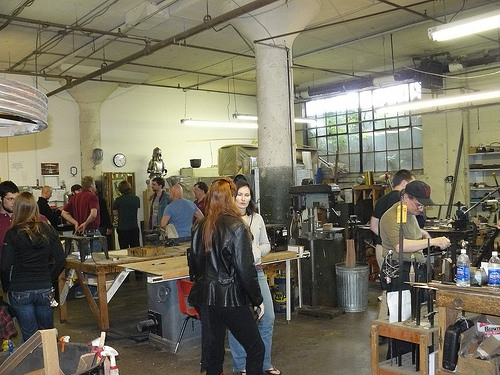
Our visit began with a tour of the Arm & Armor workshop, aka, “where the magic happens”. A&A makes some of the finest replica swords and training weapons in the business; and so our descent into the basement where their shop lies felt a bit like a trip down into Vulcan’s forge. I confess that I hadn’t pictured the facility being so *big*. It’s a sword lover’s dream, filled with all manner of weapons and armour, both finished and various stages of being “in process”. It was also fascinating to look at the pieces that Chris and Craig have kept for themselves, from one of a kind polearms to jousting harness, and see a time line of Arms and Armor’s history in the 30 years since Chris Poor first started his business, while still being a jouster on the Renaissance fair circuit. Craig showed us their forge, grinding wheels, casting molds, and explained to us how A&A designs and produces their weapons. Then he let us wander about and play, which we gleefully did.

From there, we headed over to the Oakeshott Institute. Ewart Oakeshott spent his life trying to rectify misunderstandings about the medieval sword, and to draw an appreciation for them both as artwork and as perfectly designed tools. Therefore, when he died in 2002, his will bequeathed his beautiful collection with the idea of creating a hands-on, educational museum. To house the museum, Chris Poor has purchased an old, 19th c church for the Institute, which the A&A boys are slowly renovating. Based on the amazing woodwork, vaulted ceilings and the renovations we saw going on, the Institute will be a small, but lovely museum once it is finished.

Keith Alderson met us at the institute, and was our first presenter. Keith is an  ABD (“all but done”) PhD student at the University of Chicago, specializing in late medieval, German books. He also comes from a background in Korean martial arts, kendo and knife-fighting. This combined background has given him a unique, and valued insight into the German fencing texts and I was eager to hear his discussion. Keith detailed how the four guards of the Liechtnauer system went through a conceptual evolution over the two centuries that the art flourished, beginning as leger, which Keith sees as a general position from which one engages in a certain type of fighting, and becoming hut, specific positions, or “guards” that one stands or moves into. This presentation is going to be published in a forthcoming compendium by Freelance Academy Press, and I will be interested to see how his ideas are received in the larger community.

Keith is also a  a student of the modern Bowie knife system taught by Pete at Alliance Martial Arts and Jim Keating of Comtech. Keith made an interesting point that German Ms. 3227a, the oldest Liechtenauer text (aka the “Doebringer” Fechtbuch) proclaims that all longsword fencing derived from the use of the messer, or knife. The messer was a single-edged weapon with a clipped point and “false edge”, which came in varying lengths, from a long knife to a two-handed falchion. Keith then pointed out that the messer continued right into the modern era with the Bowie knife, and showed how the “back cuts”, or false edge blows , taught with that weapon relate directly to many of the specialized blows, or Meisterhau of  German swordsmanship.  This comparison was used as a lens to interpret the historical material because the mechanics of early American Bowie knife fighting are well understood, and the actions in use could be compared not just the mechanical, but the tactical qualities of the different sword blows. The larger message was that there is a readily identifiable set of tactical and mechanical advantages that one gains when using a double-edged weapon uses both edges to strike along all eight of the basic angles of attack .

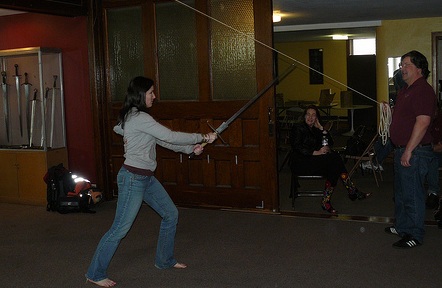
Keith was then joined by Craig in a demonstration on how the Oakeshott team is applying some of these ideas in their own martial arts practice. They walked us through a fair amount of translated passages from the “Dobringer” manuscript, and pointed out that the admonishment to cut, thrust and slice can be used as an order of operations for making an attack and pursuing follow-up actions. Craig also showed us a specialized training sword he has designed to teach students to cut in a narrow arc, instead of “round housing” their blows, and a number of Guilders tried their hands at the “sword on a rope”.

The next presenter was Josh Davis, a member of the Institute and part of the Arms and Armor shop team. then showed us the first complete harness he had made (German, late 15th c), and talked about his project in making it, and how cool it was to submit it as part of his academic work towards a  bachelor’s degree in Medieval Studies. It was a nicely made harness by any standard, but was particularly impressive for the first harness made by someone who has been armouring for only three years! He had the opportunity to fly over to England and examine a number of Gothic harnesses up close and personal to gather the understanding necessary for this undertaking, which is something that cannot be overstated as important knowledge for armour manufacture. You know, kinda like handling original swords to see what a sword should feel like …

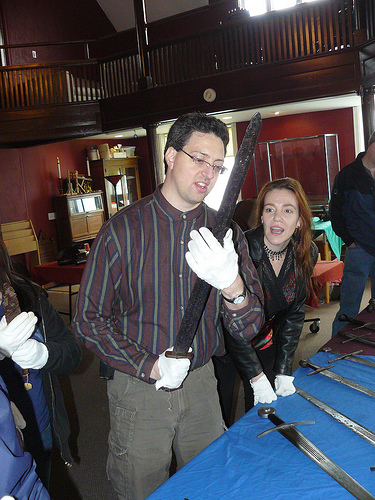
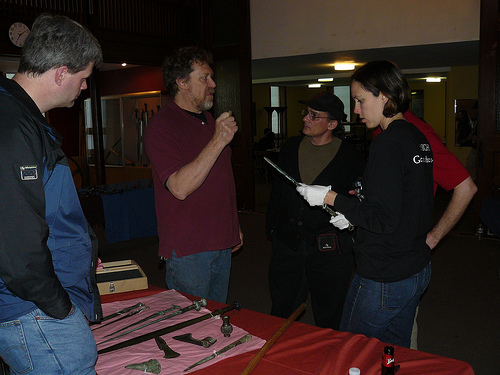
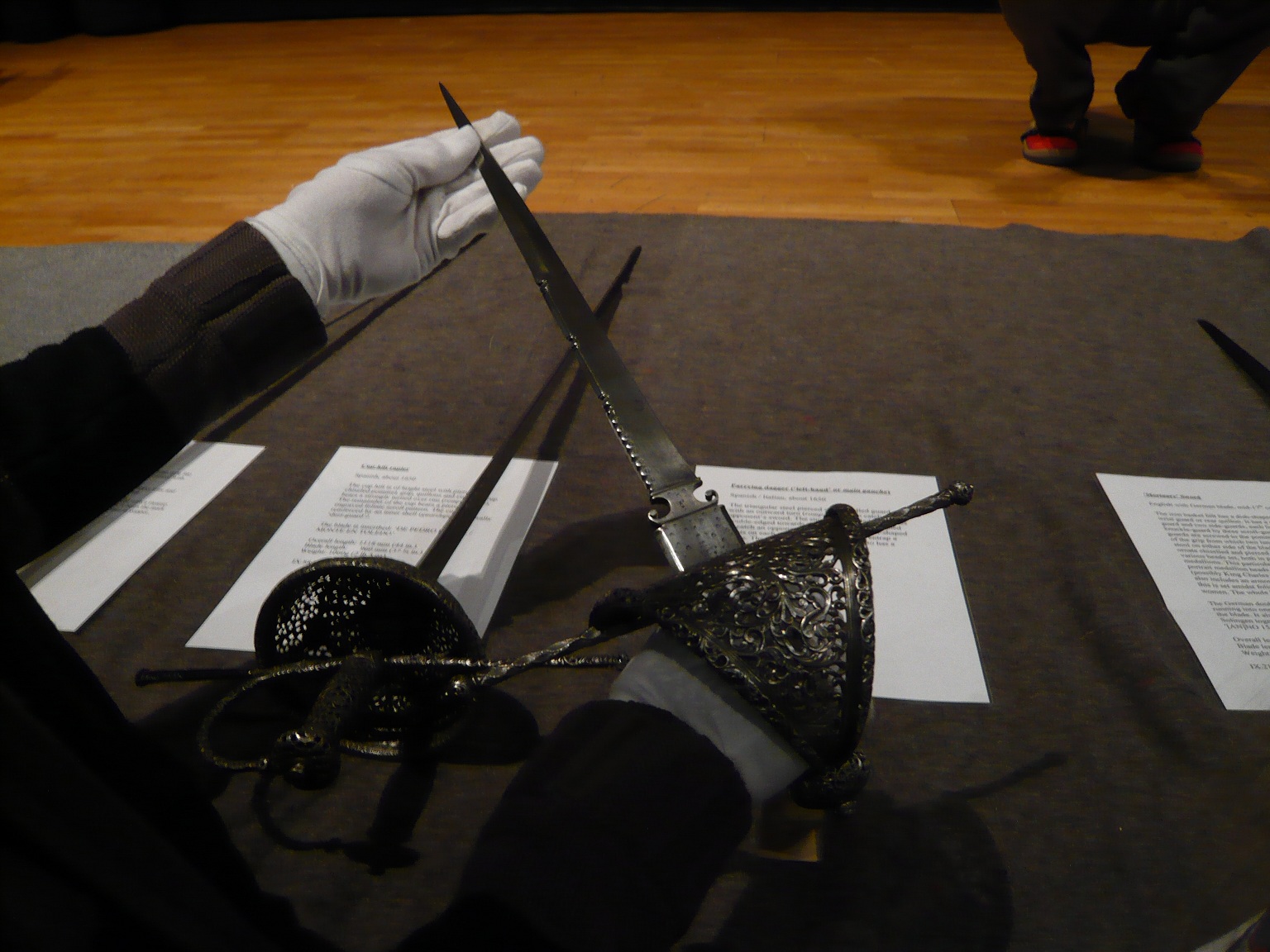
After Josh’s lecture we came to the part  where we got to play with the pretties. Pictures can do them better justice than words, in the absence of having them at hand. There were several medieval one handers from the 11th – 15th centuries, including Ewart’s prized sword “Moonbrand”, a pair of 5th century, Frankish saxes, several 16th – 17th century rapiers, several mortuary and basket-hilted swords, and an 18th c hanger in pristine condition that just begged to be used.

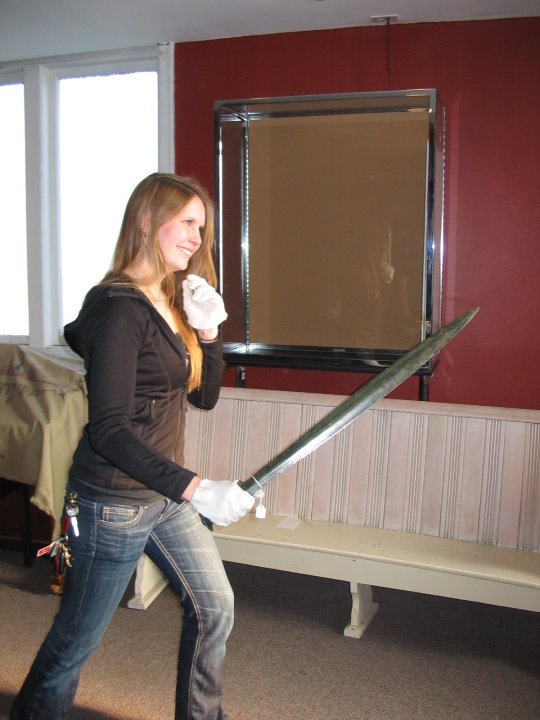
Following dinner, the Oakeshott folks treated us to a handling of some of Bronze Age pieces in their collection. Three swords, at least one spear point, a few axe heads, and a very very old mace head from Sumer that was dated to about 2000 BC. It was just astounding to handle pieces of such antiquity that were still in such usable condition – one of the bronze swords still has areas that gleam golden through its green patina.

The group reconvened on Sunday morning for Craig Johnson’s lecture about the history of European metallurgical science, text sources and illustrations relating to the same (mining the ore to smelting the blooms to pounding and forming the billets with hammers or water powered trip hammers). Of particular interest were images of more than one female blacksmith or armoursmith shown in a guild workshop context. We also went through an overview of hardness testing and ratings, examples of hardnesses on several surviving medieval and Renaissance swords (each of which were not consistent in their hardness, even within the length of one edge). There was also reference on modern steel hardness and properties, and what modern customers expect and demand a sword be made from, without any real justification for that demand based on historical examples. Which is to say, modern people look at modern tools and demand that swords be made to some of the specs of modern tools (~50-52 Rockwell hardness), without understanding that such is far harder and homogeneous than the original pieces, and thus likely unnecessary to the finished product’s function. There was also a fascinating look at the blacksmith’s tools, and how well formed they were already by 600 AD, and how they are EXACTLY the same as what we see until the Industrial Revolution. As Craig reminded us a number of times, these craftsmen had thousands of years to figure out exactly how to do what they wanted, and what was the best way to make it. They figured it out, and more often than not, when Craig and company have tried to engineer a way around a historical process involved in the manufacture of a piece, they discovered very late that it was far, far easier to do it the way it was originally done, and the result was perfectly fine.

After the lecture we adjourned together for lunch, and then it was time for the long drive home. Many thanks to Craig, Chris, Keith and  the whole Oakeshott team for their hospitality and sharing of knowledge. We hope to repeat this next year!

(You can find more photos of our trip in the CSG Flickr Gallery.)

CSG at the Royal Armouries

February 20 & 21, 2010 was the British Federation for Historical Swordsmanship’s annual conference, called S.W.A.S.H: Symposium on the Western Arts of Swordsmanship through History. Held at the Royal Armouries in Leeds, there really couldn’t be a better location for a conference on the study of historical European swordsmanship.

With 2010 being the 600th anniversary of Fiore dei Liberi’s Flower of Battle, armizare formed a centerpiece of the event schedule. Our good friends and colleagues Rob Lovett, Mark Lancaster and Mark Berryman of the Exiles were bound and determined to get a few Yanks over to teach, and went above and beyond to see that both Sean Hayes of the Northwest Academy of Arms, and myself attended.  I’m very glad that they did.

This was my (Greg’s) first time teaching overseas, we (Sean, CSG Free Scholar, Jesse Kulla, and myself) were more than taken care of, first during a few days of tourism in York, and then in Leeds. Your hospitality and friendship, and that of all of my friends in the Exiles, near and old, shan’t be forgotten!
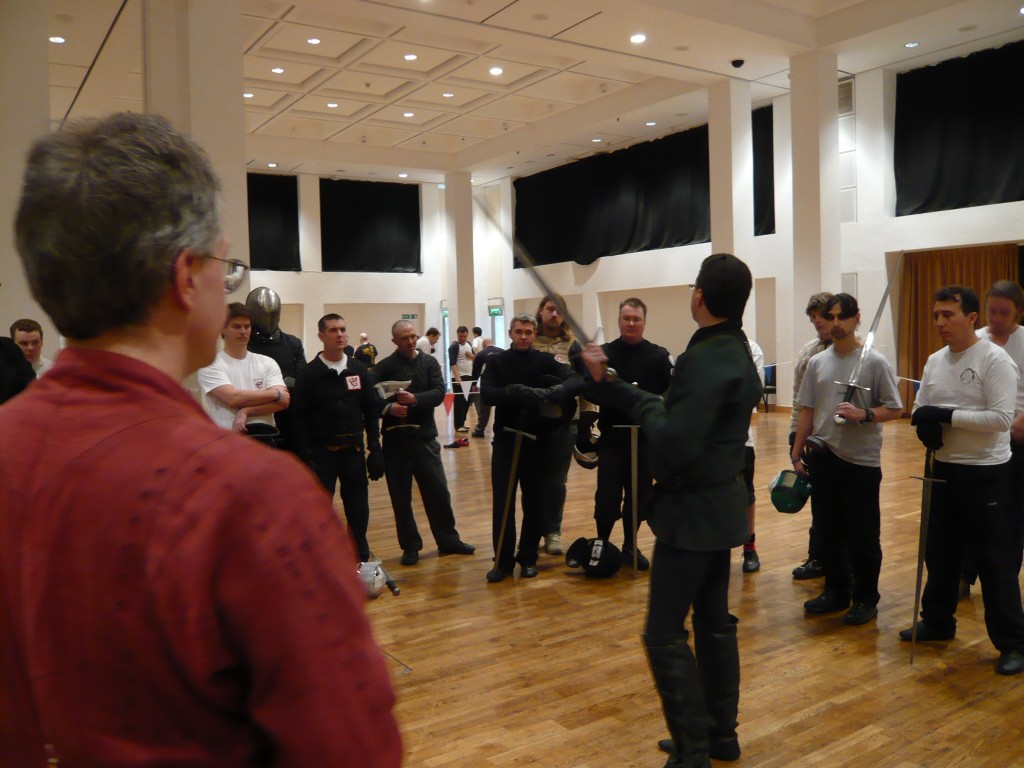
My class was on dei Liberi’s system for wielding the sword in one hand, and while there is never enough class time to cover all of the material you’ve prepared, my students were engaged, worked hard, and asked excellent questions.I also had an opportunity to participate with Mark Lancaster, Sean, and Kim from the Aberdeen Swordsmanship Group (another set of dedicated Fiore students, I had the pleasure of meeting for the very first time) in a round-table discussion and Q&A on armizare. We looked at the three volte of the sword, some questions about movement and covers in the dagger material, and a “chicken & egg” debate over what order the four surviving manuscripts may have been created in and what suggests this. The round table was certainly fun to participate in, and I think the audience felt they got something out of it. At least, they were polite enough to tell us so!
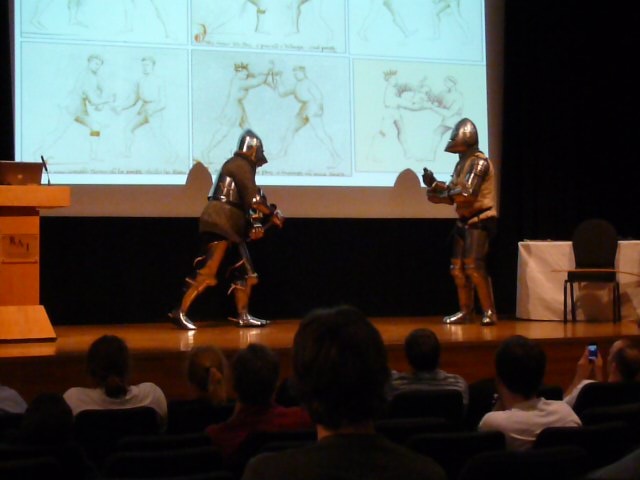
As always, Jesse was my trusty demonstration partner and assistant, and he was also commandeered by Sean Hayes for his own class on decision making and tactics with the sword in two hands. Other classes on armizare included Rob Lovett’s extended  class on how to move back in forth between using the sword in one hand, in two at wide play, at narrow play and the techniques of the sword in armour, within the context of a single fight, an intro to Fiore class for new students taught by the members of the Abdereen Swordsmanship Group, and a fantastic lecture on armour depicted in the Flower of Battle manuscripts by Barry, also from the ASG.

Concurrent with all of this was another “themed” track, focusing on 19th century antagonistics, and that most Holmesian of martial arts, bartitsu. (No idea what I’m talking about, take a peek at www.bartitsu.org.) I would loved to have seen the various  classes on pugilism and cane-fighting, but, of course, I was ‘at work’ on the other side of the room, so I only got a chance to catch glimpses vicariously. There were also classes on English two-handed sword fencing, the Italian rapier, the partizan, and a great deal more, rounding out the packed, two-day schedule.
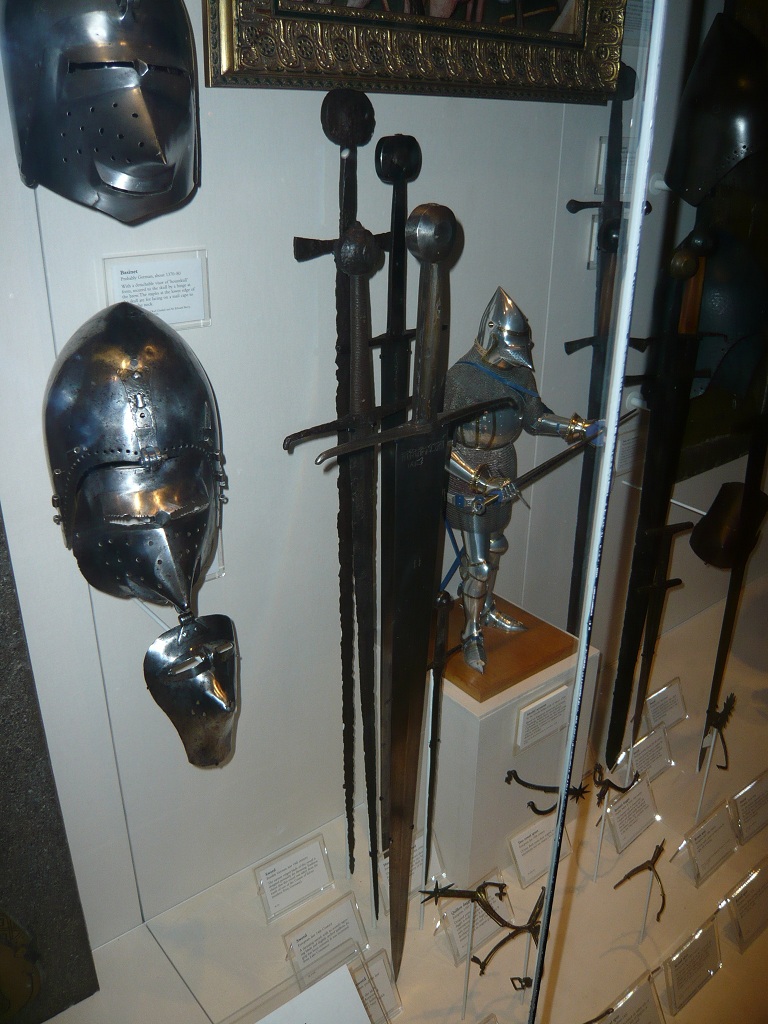
Probably the highlights from the perspective of Jesse and I was the chance to wander the Royal Armouries and be literally surrounded for two days by four flours of arms and armour, ranging from Paleolithic clubs to theoretical prototypes of “next generation” guns and body armour. The Medieval and early Renaissance collection, which naturally, was of the greatest interest to us, is just stupefying. There were some wonderful pieces that corresponded directly to Fiore’s era and his manuscript, including more bascinet helmets then I’ve ever seen together in one place, (one of which my own helmet is based upon), swords and rondel daggers, and a horse chamfron (head guard), that would have looked far more at home on the head of a draft horse, than the Andalusian breeds that seem to be the direct descendants of the medieval war horse. But one of the coolest “Fiorian” pieces had to be an early-partizan/winged spear that was *identical* to the ghiavarina depicted by Fiore for use against cavalry. I need one!
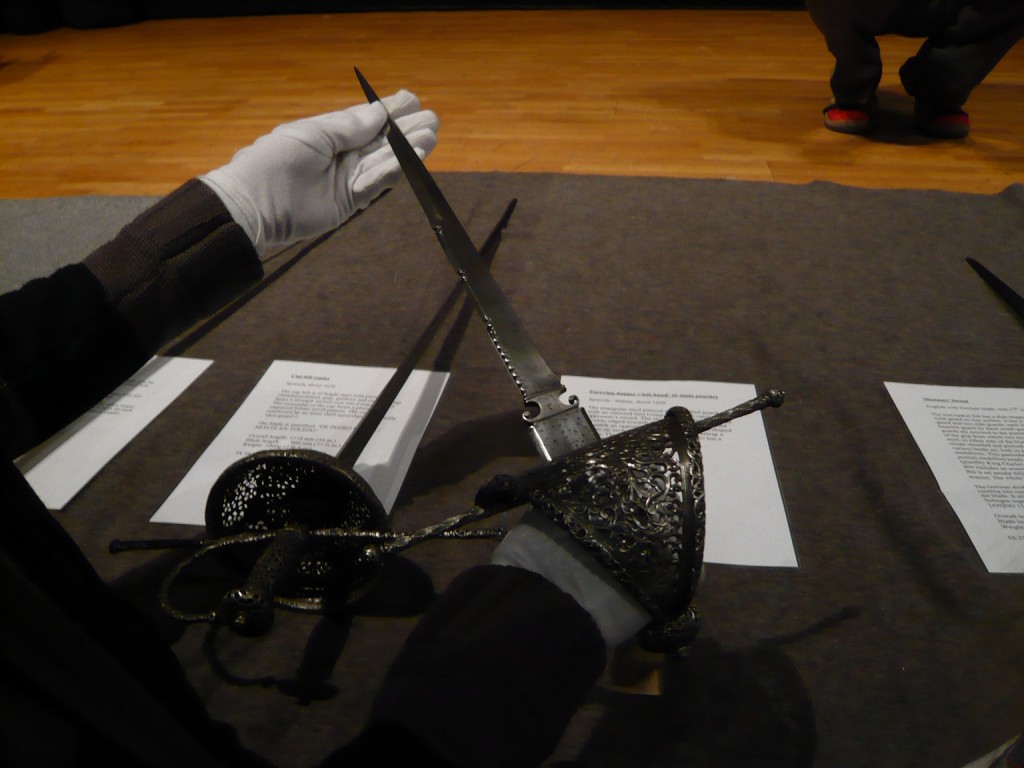
There was also a handling session arranged with the armouries, where attendees were given the chance to lay hands on a number of swords, rapiers, daggers and bucklers from the 14th – 18th centuries. While this is always an amazing experience, the more exciting part was that the Armouries curators also brought out their prized fencing treatises. This includes a colored copy of Agrippa’s famed 1553 treatise, the massive, 1620s opus of Gerard Thibault, but most importantly, the famed Royal Armouries Ms. I.33, the oldest surviving fencing treatise in the world (c.1300). An anonymous, German text on sword and buckler fencing, I’ve seen colored scans many times, including hi-resolution scans that I worked with as I helped prepare Dr. Jeff Forgeng’s modern, English translation and edition of the work. And yet, seeing this amazingly preserved work in person, the first thing that struck me was that the vibrancy of the color and “depth” of the images simply has not been conveyed in photography.It was just amazing having a chance to thumb through this piece of history.

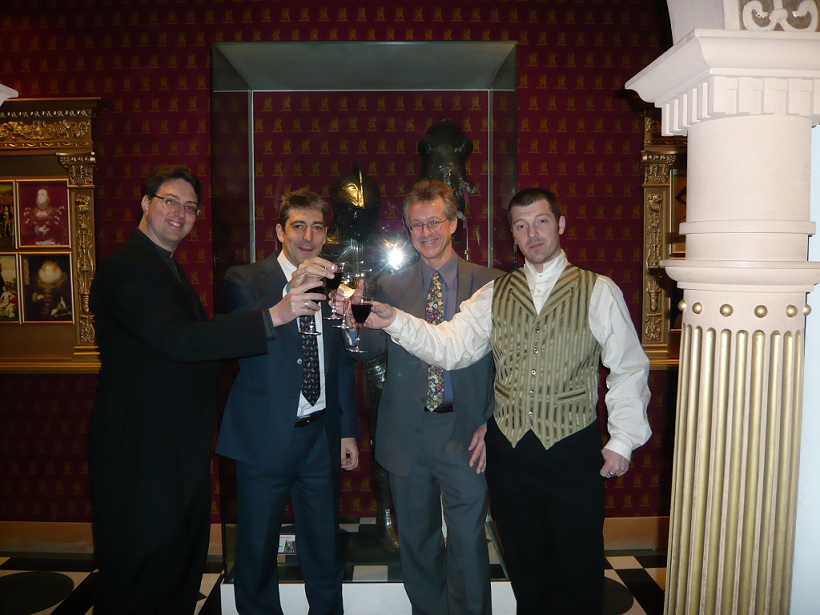
The other amazing highlight was the gala dinner, a formal event held after closing hours within the armouries itself. The evening began with a wine reception in one of the galleries, and a fascinating partizan exhibition by the gentleman from c.1595, a group dedicated to the work of the Elizabethan fencing master, Vincentio Saviolo. From there we had dinner within another gallery, surrounded by centuries of history, after which there was an hour for us to wander the museum by ourselves. It’s really hard to put into words the “wow” factor, especially for we Americans, who obviously do not have access to the sort of  material artifacts that our European counterparts do.
I also met a number of wonderful folks, both new to me, and previously known only by their posts here, from Mark Hillyard, whose modesty and affability hid an insidious plot to prove just how much weaker at beer consumption we colonials are compared to our English counterparts to Albert Bomprezzi, maestro de armas of the Spanish fencing federation AEEA – Asociacion Espanola De Escrima Antigua. Alberto is about as fine a gentleman, teacher and swordsman as you will meet. My only regrets are that SWASH’s schedule is fairly packed, and the Armouries needed us out sharply at 5 PM, so there was little time to play or compare notes without having to skip classes. I would very much like to have taken the partizan class, and was sorry to miss the antagonistics track. Likewise, I regret that my short time in the UK meant that I did not get to meet anyone who wasn’t at SWASH. England’s a small country, but six days, one of which involved travel, sure goes fast.

By the time Jesse and I returned home, lack of sleep, English beer and jet lag had all taken their toll, but it was well worth it for a very magical week in Merry Olde England.

New Source for Western Martial Arts Books and DVDs!

Dear Friends, Students of the Sword and Lovers of History,

We are proud to announce the debut of Freelance Academy Press, a new publishing venture by Tom Leoni, Christian Tobler and CSG’s co-founder Gregory Mele.

Freelance Academy Press offers its readers both innovative books and rich supporting material in the fields of Western martial arts, American and European history, arms and armour, chivalry, historical arts and crafts, and related fiction for adults and young-adults. We accomplish this through the introduction of new educational books and timeless, carefully selected reprints. Each of our titles features innovative cover composition, clear illustrations, high production value and solid binding. Our goal is to give book-lovers a product in which the quality of the subject is matched with a notable degree of professionalism and cleanness of design.

Freelance Academy Press: Something Different

Our goal is to be more than just another publisher, and our name “Freelance Academy Press” reflects our core structure and philosophy. As with many modern expressions, the origin of the term freelance has largely been forgotten. Originally, a “free lance” was a knight for hire, which in the modern world now means an individual hired to do contracted work.

The foundation of a publishing house is determined by the quality and diversity of its catalog. We are keenly aware that the structure of our business is built on establishing solid, enduring partnerships with our freelancers – our authors. That is why we collaborate with our authors to shape and refine their vision into a work that will withstand the test of time.

If freelance is our structure, then academy is our philosophy. Since we are passionate students of the subjects we publish, we are invested in seeing interest and knowledge of our titles grow on a global basis. We carefully choose titles and materials that lead readers on a historical journey that does not merely end with the final page of a book. Instead, our philosophy incorporates the three-tiered approach of Discover-Learn-Experience:

Discover – Freelance Academy Press broadcasts and promotes the existence of fascinating topics such as Western martial arts and the modern communities that exist within this rapidly expanding arena. By doing so, we help these communities to grow and we encourage interaction between the individuals within them.

Learn – We provide high-quality instructional and translational works for our readers. Because even the most scholarly of historical works should not be dry and boring, we emphasize readability and visually-compelling presentation in order to make your journey back in time a stimulating adventure.

Experience – In today’s publishing world, a press must be about communicating ideas, not merely about printing books or DVDs. We encourage you to return to our website, in particular our blog, time and again. We promise that you will find it to be an ever-growing repository of supplemental training documents and video clips, featured interviews and Q&As with leading researchers and instructors, and free downloadable e-books and translations. As a further bonus, subscribers to our periodic newsletter will receive “sneak peaks” and advance news of new title releases, as well as pre-order discounts and a few other surprises.

In short, Freelance Academy Press is run by aficionados of Western swordsmanship, for aficionados of the Art of the Sword. We seek to forge an interactive, on-going relationship between reader, author and publisher that is well beyond the model of a traditional press. We invite you to come to www.freelanceacademypress.com now and join us on this odyssey.

Freelance Academy Press: Interact with History